

NEXUS – Human Factors Training
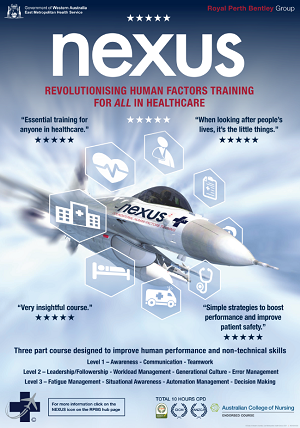 As part of the Royal Perth Bentley Group's commitment to delivering consistent, high-quality care, and with an aim to address any training deficiency in Human Factors and Performance in healthcare, a dedicated team has carefully adapted and developed learnings from other safety critical industries that complement the technical expertise required in the complex healthcare environment.
The result is the NEXUS Human Factors Training Program -- a course aimed at educating the entire healthcare team from medical to nursing, allied health to corporate and patient support personnel.
The primary focus is to improve patient safety by minimising human error, promoting teamwork, developing leadership and improving workplace satisfaction in all areas of health service operations, creating a culture of continuous improvement across the workplace.
The course has three levels, to be completed sequentially. Course dates for 2025 are shown below.
Fellowship Opportunity:
Supervisor: Dr Thy Do
Royal Perth Hospital is the first Australian hospital to deliver formal, standardised, foundational Human Factors (HF) training to their staff. These positions will assist in shaping the future directions of this centre of excellence and help integrate HF into organisational processes.
Quarantined time for clinical support activities will complement clinical experience. Fellows will supervise and provide clinical teaching to more junior trainees, and foundational HF teaching to other healthcare staff in the hospital, both in- and out-of-hours.
This role will interface with the Department of Anaesthesia and Pain Medicine, the Director of Operations for the Nexus Foundational Human Factors Training Program and other members of the Hospital Executive Team (Director of Clinical Services and Safety & Quality Division Leads) to assist Royal Perth Bentley Group in achieving its vision of becoming Australia’s safest healthcare group.
30 hours per week in anaesthesia duties and standard anaesthesia on-call requirements, plus10 hours per week in Human Factors-related projects.
HF Fellows will identify their own area(s) of interest in any combination of research, audit, teaching, and administration.
In collaboration with the fellowship supervisor and the relevant leads for their area(s) of interest, they will develop an individualised plan for the use of their CST, with supervision and support provided to ensure these goals are met.
2025 Dates:
Royal Perth Hospital
Venue: WASON Building, Classroom A
|
Level 1 & Level 2 8am – 4.30pm
|
|
|
Level 1 8am – noon
|
|
|
Level 2 8am - noon
|
|
|
Level 3 8am - noon
|
|
Bentley Health Service:
Venue: A Block Training Room
|
Level 1&2 8am - 4.30pm
|
|
|
Level 3 8am - noon
|
|
Armadale Kalamunda Group
Venue: Tony Taylor Seminar Room, Armadale Hospital
|
Level 1& 2 8am - 4.30pm
|
|
|
Level 1 noon - 4pm
|
|
|
Level 3 noon - 4pm
|
|
The NEXUS Foundational course consists of three levels, to be completed sequentially, whereby each level is built upon the previous.
The course is structured to enable participants to link concepts learned across all nine modules, learning tools and strategies that can be translated into the work environment.
Level 1
- Awareness – why Human Factors are important in healthcare.
- Communication – tools and strategies to strengthen your communication.
- Teamwork – understanding the pitfalls of team dynamics.
Level 2
- Leadership and Followership – the importance of this training in healthcare.
- Workload Management – understanding the task causes of workload.
- Generational Culture – breaking down the negative stereotypes of each generation to optimise team performance.
- Error Management – defining, understanding and classifying errors.
Level 3
- Human Performance / Fatigue Management – learn how you can manage your biggest limiting factor in human performance.
- Situational awareness – how it’s built, lost and retrieved.
- Automation Management – human vs technology centred design. What are the implications for the Healthcare industry?
- Decision-making – intuitive and analytical. Learn a structured method for decision making.
How to Register:
EMHS Staff
If you are an EMHS employee, you can enrol via NEXUS Registration - My Learning (access this link from the internal network).
*Levels must be completed in order (1, 2, 3).
Non-EMHS Staff
If you are from another external Health Service Provider, please email and attach the appropriate invoicing form below stating which date you wish to attend.
If your team or department would like to do our NEXUS course, please email us directly so we can accommodate accordingly.
Please complete an invoicing form relevant to your employment location (below).
Please forward the completed form to
RPBG.NEXUS@health.wa.gov.auInvoicing forms:
*Levels must be completed in order (1 > 2 > 3).

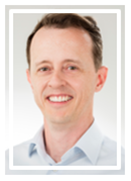 Anthony Lock, DSM
Founding and Strategic Director NEXUS Program RPBG Royal Australian Air Force, Reserve Squadron Leader Pilot at No. 25 Squadron, Perth, Western Australia & Air Transport Pilot’s License holder – Boeing 737 Domestic and International Operations.
With over 6000 flying hours on various high-performance aircraft, Anthony has extensive experience within the aviation industry. During his 25 years in the RAAF, as an engineer and pilot, Anthony developed an expertise for working with high performing teams in demanding environments – leading and training teams in Human Performance for success.
During combat operations in Iraq and Afghanistan and humanitarian/peacekeeping missions throughout Asia, Anthony saw immense value in Human Factors awareness and continues this learning in the civilian airline industry.
Anthony gave up an airline career to work full time at the Royal Perth Bentley Group as the Director of Human Performance Training and leads the Team Development & Nexus Programmes. He is passionate about working with people to achieve their best and continues his studies in Human Performance and leadership development while working with various healthcare safety groups around the country.
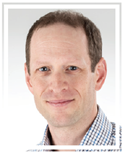 Dr Jon Spiro, MBBS BSc MD MRCP FRACP
Consultant Interventional Cardiologist, Royal Perth Bentley Group
Founding and Strategic Director NEXUS Program RPBG
Director of Catheterisation Laboratory, RPH
Clinical Senior Lecturer, University of Western Australia
During his medical training and working as a Consultant, Jon has built up a special interest in leadership and teamwork within healthcare groups and organisations. Through working with partners from other industries, such as military and aviation, Jon has developed a particular focus on improving patient safety and clinical efficiency.
In addition to working as a fulltime Interventional Cardiologist and Senior Clinical Lecturer at UWA, Jon is also the Clinical Lead for the Team Development Programme at RPBG.
This initiative works with healthcare teams to improve teamwork, leadership, and ultimately patient safety while equipping healthcare workers with specialist training in communication, situational awareness, threat and error management and decision-making.
 Dr Thy Do, BSc (Hons) MBBCh (Hons) FRCA FANZCA
Consultant Anaesthetist, Royal Perth Bentley Group
Operational Director NEXUS Program RPBG
Secretary of SAS (Safe Airway Society), Australia and New Zealand
Founding Director Ready, Steady, Gas! SIM A Human Factors Course, UK
Simulation Instructor (ALS2, SimStart WA, ATTAAC)
After graduating from Cardiff University, Thy completed her anaesthetic training in the West Midlands, UK. Her passions include airway management and simulation training with a focus on human factors. She developed and implemented a regional human factors training day in the UK for senior anaesthetists, blending HF and simulation based on the RCoA ANTS framework. Thy is faculty for WA Department of Health pre-approved Train The Trainer (TTT) simulation instructor course; SimStart and faculty for national simulation course ATTAAC (Advanced Technical and Teamwork training for Anaesthetic Airway Crises). She is also a formal instructor in CICO (Can't Intubate, Can't Oxygenate) Rescue techniques, teaching at airway workshops and TTT courses on a national and international basis.
Thy continues her extensive involvement in regular inter-professional team training locally and nationally. She is actively working with other like-minded individuals to further integrate the science of Human Factors into Healthcare seeing the benefit for both patients and staff. Thy is a member of the Clinical Human Factors Group, UK and Healthcare Ergonomics SIG Committee for the Human Factors and Ergonomics Society of Australia (HFESA).
"Awareness is the first step to improve our Human Performance as human factors (HF) can neither be avoided nor eliminated. I have been subject myself to the pitfalls and fallibility of HF affording me lessons which have been both sobering but extremely valuable. My friend's sister, a trainee doctor driving home from night shifts was involved in a serious car crash and suffered a brain injury with serious consequences. This is just one example where I realised how important managing HF is. We need to understand ourselves and the team around us. What strategies can we adopt to better manage the personal and professional challenges we face at work? My understanding of HF continues to deepen as time goes by. Healthcare is complex. The more of us in the team with a shared language and understanding, the better equipped we are to care for ourselves, our colleagues and most importantly, our patients. I hope you will jump on board with us!"
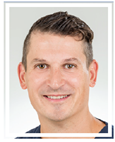 Dr Adam Howard, MBBS FCICM
Consultant Intensivist, Royal Perth Bentley Group and Armadale Health Service
Consultant Hyperbaric Physician, Fiona Stanley Hospital
NEXUS Facilitator
Simulation Instructor
Adam’s interests include simulation training, airway management in the critical care environment, tracheostomy care, staff wellness and mentoring. Adam has developed a number of inter-professional simulation courses within RPBG.
Over the past few years I have grown increasingly interested in non-technical skills within healthcare. Patient safety is paramount; working in high acuity areas throughout my career, I have seen how stressful situations can change the inter-professional workings of ‘the team’. Focusing on Human Factors helps to strengthen and unify the ‘team’ approach of caring for patients and supports staff wellbeing. The NEXUS course is a great introduction into the multi-faceted understanding of human factors, and is applicable to all healthcare workers. I really enjoy meeting the diverse participant groups, listening to their voices and experiences. It continues to deepen my understanding and passion for HF in healthcare, bringing about positive changes for patients and staff alike.
 Erin Bridson, Bsc Nursing, PGCert Clinical Nursing (Intensive Care)
Staff Development Nurse, Intensive Care Unit, Royal Perth Bentley Group
NEXUS Facilitator in Training
Erin has 20 years of nursing experience within regional, remote and tertiary level hospitals, with a primary focus on critical care. Erin works within RPH ICU as a clinical nurse and a staff development nurse with an interest in interprofessional education, simulation training and critical care delirium.
“Within my dual roles, I develop and encourage interprofessional education for Intensive Care Staff. There is a powerful force associated with an effective team, one where the synergy of teamwork provides best outcomes for healthcare professionals, patients and their families. The critical care environment is frequently an unfamiliar and confronting place to work. Provision of HF education allows the interprofessional team to develop a team culture that supports all level of staff. Within my experience of developing and facilitating multiple interprofessional education sessions, I have discovered that incorporating HF education is essential to providing holistic health professional education. I am excited to be part of the NEXUS team and provide HF training for all healthcare professionals.”
It's always encouraging to hear how the NEXUS training is making a positive impact in the healthcare industry! Have a read below of our favourite anecdotes we have received on the cultural influences and organisational changes being made across healthcare, in both clinical and non-clinical environments.
"Roger that", "MVA rollover, x3 patients, unknown age, x1 ejected with CPR from by stander". This is a job card that we as paramedics see on a very infrequent basis. Preparing for unprecedented cases like these can be extremely difficult and stressful. The overwhelming influx of nerves and anxiousness is real, and happens to the best of us. I was fortunate to attend this case only days after completing the NEXUS course, with a 25 minute priority 1 drive to the scene, I was able to apply the principals of NEXUS training whilst performing a pre-arrival debrief. Generally, on cases like this it is common to spark non clinical conversation on-route to cool our nerves, however in this case we kept a sterile cockpit. We as a team remained focused on prioritising our plan and how to troubleshoot the variables we may encounter. This proved highly effective with a sense of confidence in controlling the chaos on scene and maintaining a clear vision where stress inoculation was significantly reduced. Throughout the treatment and management of this case I verbalised the STAR model out loud, this actively prompted me to reassess the situation and act with a conscious, clear thought process. The training NEXUS provides is a highly valuable resource when exercising best practice and maintaining the highest degree of patient safety."
Nathan – Paramedic and Registered Nurse, St John Ambulance WA
"As well as singing the virtues of NEXUS, in a simulation last week I used the NEXUS phrase "we need to slow down, as we are in a hurry". This resonated beautifully with the participants in acknowledging that during times of stress, in order for a team to truly perform to its maximum, it is vital to take a moment, slow down, ensure everyone is on the same page, gather opinions and info, and properly task delegate.
I have also found the use of blindfolding in simulation training a very powerful means of emphasising the need for "closed loop" communication, just how noisy and chaotic communication can become if everyone chats at the same time. It also empowers more junior, potentially shy doctors to understand the need to front up and approach the team leader with their vital bit of information, as opposed to hiding in the crowd."
Rory – Medical Education Unit, Fiona Stanley Hospital
"After completing all three NEXUS Levels in December 2018 I have implemented team pre-briefs every morning and it's been working so well!
We provide a dietitian service to eight wards. Before we started with pre-brief I found that the team was becoming flustered at times, with a very heavy workload. Although we all have a good working relationship, we were not communicating effectively or enough regarding our workloads and non-clinical duties. Since implementing the pre-brief, we catch up every morning for a 10min discussion on workload, non-clinical tasks and deadlines. Everyone now knows who is on shift that day, what the urgent tasks are that need attention, and we feel like we are more in control of the clinical workload, which in turn has improved the team's moral, and on busy days the work efficiency and communication is at its best.
Thanks for all these brilliant ideas NEXUS Team!"
Effie – Dietetics Department, Armadale Kalamunda Group
"I really enjoyed the course. I have made it a personal mission to learn the names of everyone in my area on every shift as we have a different combination every day and often have agency staff. This alone has created a palpable difference in communication and enthusiasm in our area. Also, at the start of the shift, we have a 'chat' to look at workflow, and see who is in the coordinators role today. Such simple changes, yet very effective. Very much looking forward to what Nexus has to bring in the future!
Rose – Radiology, Royal Perth Bentley Group
"Thank you very much for the opportunity to participate in your innovative program – I have gained refreshing insights into new and previously visited topics and have appreciated being taught so many tips to help improve my work practices, and attitudinal and behavioural skill sets.
Even working as a non-clinician in revenue/finance, I am still able to able to apply the training to myself, own work environment and management job.
With sincere thanks and gratitude."
Susanne – Finance, East Metropolitan Health Service
"NEXUS has taught me specific tools and techniques that I have been able to implement straight away into my clinical practice and improve patient safety. Soon after finishing the course, I used the PACE Model (Probe, Alert, Challenge, Emergency), a method of graded assertiveness, to highlight a potential safety issue when discussing a possible inter-hospital transfer of an unwell patient with a specialty team. Luckily I didn’t have to utilise the “Challenge” statement section of the model, as the registrar acknowledged the concerns and safety risks I raised and changed the patient’s plan accordingly. Utilising the PACE model gave me the confidence to express my concerns for the patient, that I perhaps may not have had the confidence to do so without this newly learned method. I can definitely recommend this course to all clinical and non-clinical staff, the tools and techniques I have learned have been invaluable."
Timothy – Resident Medical Officer, East Metropolitan Health Service
"After completing my NEXUS training I found myself in a situation at work where I needed to apply the assertive statement framework, which I carry on my lanyard. Whilst getting some emergency drugs out for my anaesthetist, I kept being interrupted by the surgeon, who was asking me to get some dressings. I had the confidence and knowledge from NEXUS to use the framework and explain the importance of a ‘sterile cockpit’ during drug dispensing to minimise mistakes. It was also good because the surgeon had not realised the impact of their distractions.
I’m very grateful I was able to be involved in this course as it has helped me in providing the best care possible to my patients, while also keeping myself and my team-mates safe. I feel it has contributed to our Servio commitment to my patients, fellow colleagues and myself."
Sophie – Registered Nurse, Royal Perth Bentley Group

Contact Us
Send an email
Approved CPD activity by the Australasian College for Emergency Medicine.

Endorsed by ACN CPD. Ten hours as per Nursing and Midwifery Board of Australia – CPD Standard.

Accredited for 2 points per hour by the College of Intensive Care Medicine of Australia and New Zealand – CPD accreditation for Category 2B.
© Copyright State of WA, EMHS 2019.
All NEXUS course materials remain the property of EMHS. Any use must be done with proper citation of the author and copyright holder. No derivative works. For commercial use please contact the author. All other enquiries, contact the RPBG Executive Director.